Archive for June, 2008

I freed myself from e-mails – Luis Suarez

My friend and colleagues Luis Suarez wrote an article for the NYTimes about his very public project: giving up on work emails. Luis is a social software evangelist and community builder with IBM Software Group, which basically means he explores new and innovative ways of collaboration. He’s also a great public speaker, if you need someone to talk about social media.
Not sure what triggered his experiment (now entering week 21), but the ripples are still visible.

The leading internet news site in Israel, ynet.co.il, also picked up the story, translated it, added some personal commentary and link to the original article of course. Reading the Hebrew article, I realized I wasn’t the only one struggling to come up with an Hebrew word for ‘Evangelist‘. The author simply wrote evangelist, only in Hebrew.. 馃檪

Links:
I Freed Myself from E-mail’s Grip – NYTimes.com
Your inbox is a catalyst for productivity – Ed Brill


Blocking return receipts in Lotus Notes

Was working with a colleague the other day, both in our Inbox, when all of a sudden there’s that shout: ‘I hate return receipts!‘.

For those not in the Inbox-ing business, I’ll explain, briefly: say you just sent an email and want to make sure people actually see it and not delete it. There’s an option that allows you to track the email, and get an email response when the other side sees it – called ‘return receipt‘. The accepting side, if he know where to look (bottom status bar), sees a quick message saying ‘return receipt submitted’, and has little time of stopping that process in the outbox.

I was poking around the floor, getting the feel of IBMers to that ‘big-brother‘ option, when stumbling upon Alex Varshavsky, Rational Sales Mgr. at present, Lotus developer in the past. Alex told me he had already wrote a code that blocks it. Great!!

From developerWorks:

Return receipts can reassure people that you received their email message. But have you ever wanted to block a return receipt? If so, you’re in luck. You can have the option of blocking a return receipt before it is sent by doing the following:

  1. In Domino Designer, open the ($Inbox) folder of your mail database.
  2. Select the QueryOpenDocument event in the Objects window.
  3. Select Formula in the Programmer’s pane, and then copy and paste the following code into the pane:
    @If(@IsAvailable(ReturnReceipt);
    @If(ReturnReceipt = "1";
    @If(@Prompt([YESNO];"Return Receipt";
    "Delete Return Receipt?");
    @SetField("ReturnReceipt";"0");
    "");
    "");
    "")

Here’s the full article, at developerWorks.

And yes, I know Outlook 2003 has it out of the box. Fine.
But I bet Alex feels super knowing he developed something helpful for the benefit of the community !!

Implementing E2.0 @ IBM – BNHP workshop

Earlier this week I had the pleasure of speaking at a management workshop of Bank Hapoalim about Enterprise 2.0 and IBM’s experience with implementing such tools and solutions.

I made some changes to my slides after the presentation, and posted at slideshare.net/dvirreznik.
Love to hear comments and feedback.

E2.0?! Can you start from Web 1.0 please?

Today I had the privilege of speaking at a management workshop of one of the largest banks in Israel. The workshop was held at the bank’s education center, 30min outside of Tel Aviv, with a beautiful view of the ocean. This was one of the cases that I came to lecture through the community. The management workshop was given by an outside consulting company, that heard me speak at a recent conference. Another proof of the power of social media.

I was told to present ‘the IBM story’ of E2.0 adoption (Web 2.0 goes to work), meaning what we’re doing, internally, to foster knowledge sharing and participation. I took couple of my presentations, consolidated slides, made some adjustments, added the IBM angle, and I was ready to go.

The population was mixed in age, all in managerial positions at the bank, youngest one in the room was me 馃檪 Only when I asked people if they knew what twitter is, I realized that most people had no idea what Web 2.0 is all about, not to mention E2.0. That’s when I decided to skip some slides and explain over a whiteboard what we’re talking about…

I won’t tell the entire 90min presentation here, only summize with this:
At the beginning of my presentation a lady asked me what’s the benefit in all that user generated content (blogs, comments, wikis, articles, etc) if most of them are garbage (or below average), and why should any organization consider adopting such tools. At the end of the presentation, she asked me what’s the top 7 blogs to follow. And she’s also the one responsible for the title of this post. Folks, change is possible! even in a ‘traditional’ business as a bank.

As for the slides: I had to make some ad-hoc changes during the workshop, so the slides will be posted later this week.

BTW – if you haven’t subscribed to Jeremiah Owyang by now, shame on you!
His posts are right on the mark, and his knowledge in social media is infinite!
Only today we were talking at the workshop about FSS examples for social media (ROI/VOI), and there’s a list availble. We also talked about Gen Y and why they care if a bank has IM or a facebook thing, and here’s another post.
Subscribe. Now.

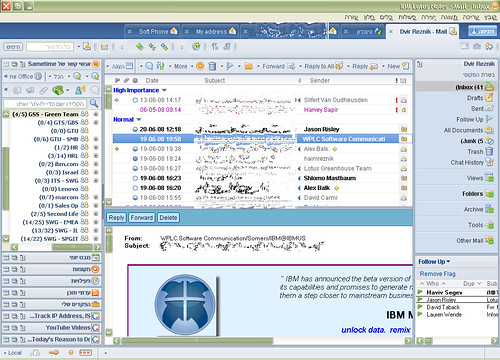
Sent from Lotus Notes 8.0.1 Hebrew Client

Started using the Hebrew client of Lotus Notes 8.0.1 this week, as a personal experiment on one hand and from a business stand-point on the other.
Even thou most organizations in Israel are using an English UI of their messaging client (Outlook or Notes), Hebrew is (and always will be) a preferred language in Israel. IBM has been investing heavily into bidi (Bi-directional) these past years – part of the ‘holy’ work my friend Dina Ben-Elissar was doing, at IBM Globalization Center in Israel.
Developing a client is Hebrew includes two major steps: First, language – Hebrew (and Arabic) are written from right to left; second, UI (user interface) – which means the client needs to be mirrored. As with any software product, there’s no 100% QA – that’s the nature of software, and some things can only be found from daily usage.

I hope my usage of Lotus Notes 8.0.1 will encourage other IBMers to follow my suit – it’s a very cool looking client !! (click here for a larger screen shot)

Next Page »